How to Track Inventory in the CRM
July 25, 2026 · tropicalhilladmin
Inventory tracks stock levels for the parts and materials you keep on hand — it's built directly on top of the Service Catalog, so anything you already price out on estimates and invoices can also carry a running stock count.
Turning on tracking for an item
Inventory doesn't track anything by default — you turn it on per item in the Service Catalog.
Open a catalog item and check Track Inventory.
While you're there, fill in SKU and Cost if you track them, plus a Reorder Point and Reorder Quantity — the reorder point is what drives the "low stock" flag on the Inventory page.
Only items with Track Inventory turned on ever show up on the Inventory page — everything else in your catalog is unaffected.
The Inventory page
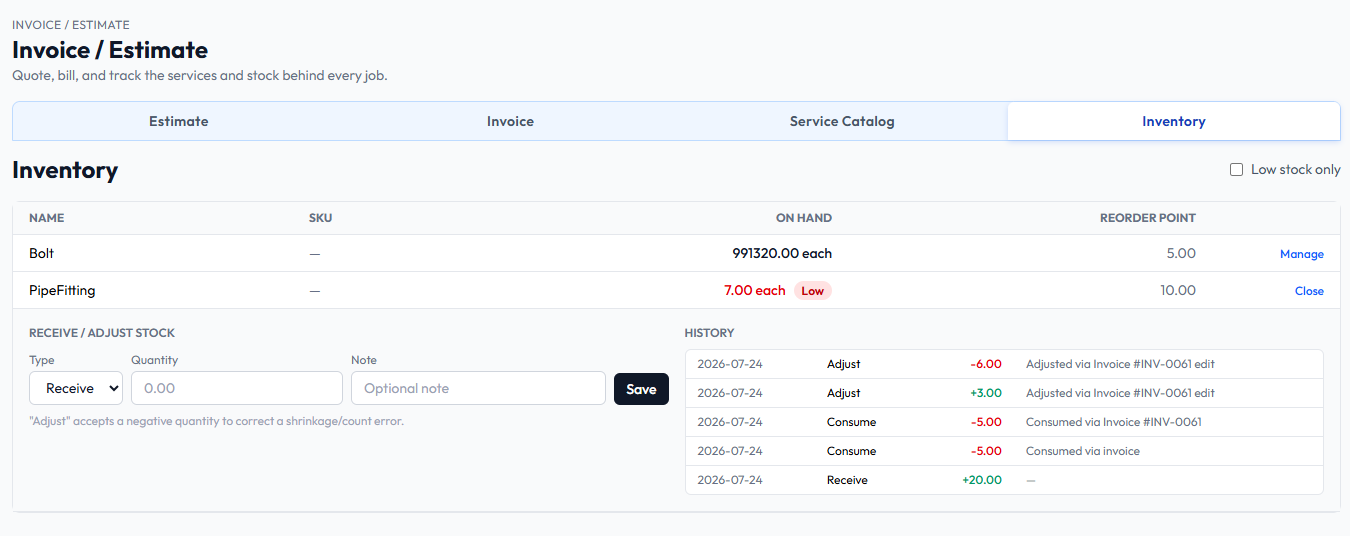
Lists every inventory-tracked item with its Name, SKU, quantity On Hand, and Reorder Point.
An item shows a red Low badge the moment its on-hand quantity drops to or below its reorder point.
Check Low stock only to filter the list down to just what needs attention.
If the page is empty, it's telling you exactly what to do: no catalog items have Track Inventory turned on yet.
Receiving and adjusting stock
Click Manage on any item to expand it and record stock movement.
Receive adds stock — use it when a shipment or order comes in. The quantity must be positive.
Adjust is for corrections and accepts a negative quantity — use it to true up a count after a physical inventory check or to record shrinkage/loss.
A Note field is optional but worth using — "PO #1042" or "damaged in transit" is a lot more useful six months from now than a bare number.
Every item keeps a running History of its transactions — date, type, quantity change, and note — visible right below the Receive/Adjust form when it's expanded.
Stock also moves on its own
Not all stock changes are manual. When a recurring Job generates an invoice and one of its line items is tied to an inventory-tracked catalog item, the CRM automatically records a consume transaction — a negative quantity change logged with a note like "Consumed via job billing" and a reference back to that invoice.
This happens without anyone touching the Inventory page directly, so if a quantity looks lower than expected, check the item's History first — a job invoice going out is the most likely explanation.
Consume transactions are the only kind you won't create yourself from the UI; Receive and Adjust are the two manual options available to you.
A few tips
Set a realistic Reorder Point, not zero — zero only flags an item after you're already out, which defeats the purpose of a low-stock warning.
Check Low stock only as a regular habit (weekly, or before ordering supplies) rather than scrolling the full list looking for red badges.
Use Adjust with a note every time you do a physical stock count — a documented correction is far more useful later than a mystery jump in on-hand quantity.
If a job consumes materials you don't actually want auto-tracked (e.g., something billed by the job, not the unit), leave Track Inventory off for that catalog item.